Saturday, March 27, 2010

Duckfest 2010 @ MUMU Grill

70-76 Alexander St, Crows Nest
7 courses of duck prepared by Craig Macindoe (MUMU Grill) and Ben Cooper (St Ali)
$95 pp including wines

It's hard to pare down my favourite foods to a top 5, or even top 10. But if I were served duck, cooked any which way, for my last meal, I would die a happy woman.

When it came to the day of Duckfest, I made it a point to not eat until I got to the much loved MUMU Grill so that I was armed with a clean palate and a spacious belly.

The night starts off with a glass of 2007 Polin & Polin Verdehlo, duck liver pate and a quick chat with Craig. The food is mostly prepared, just awaiting some final touches. All is calm here, not a hint of stress or doubt in sight. He tells me that there is such a long waiting list that a second Duckfest has sold out in Melbourne. By this point I'm gushing like an excited schoolgirl because I know that dinner will not disappoint.

Duck consommé

The rich flavour of the duck stock is cut through with the freshness of the spring onion. Imagine the deliciousness of duck juices trickling down your fingers when eating roasted duck. Now imagine a whole cup of it. Yum!
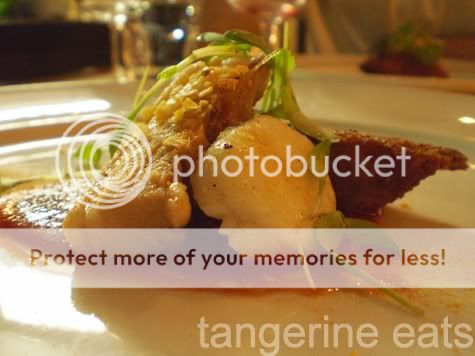
Duck breast with deconstructed XO

Served with a 2008 Little Yerring Pinot Noir. Crispy deep-fried duck breast and scallop are coupled with a hot and sour XO sauce.
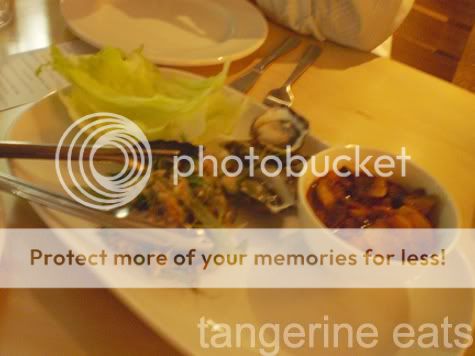
Duck sang choi bao - flash-fried duck leg with kim chi and oyster in lettuce leaf

Served with a 2008 Bass Strait Pinot Noir. The duck is so tender that it reminds me of really smooth gow gee filling. It goes well with the pickled ginger and mushroom in the kim chi and oyster.

Twice cooked duck with bok choy and poached pear

Served with a 2003 Parker Estate Cabernet Sauvignon. The meat just falls off the bone as I plate myself up a small portion. The fattyness of the duck is complemented nicely by the sweet acidity of the pear.

"Turducken" - turkey stuffed with a duck, stuffed with a chicken, stuffed with a guinea fowl

Served with a 2003 Ada River Cabernet Sauvignon. I can't tell you how excited I was for this, and it definitely lives up to my expectations. An amalgamation of turkey, duck, chicken and game bird flavours, each layer juicier and more tender than the last.

Duck egg caramel with pineapple and papaya

Served with a Pink Muscato by Innocent Bystander. This is by far my favourite. You can taste the duck fat in the sticky caramel on top. Underneath is a custard that tastes of sweetened duck egg yolk. It is a dessert of complex flavours and the fruit and fresh mint tie it all together.

By the end, Dan and I were just in awe of how amazing the food was and how gracefully the night unfolded. I love it when a menu is creative and it's executed beautifully, especially with a food that is notoriously difficult to cook. Kudos to Craig and Ben for an unforgettable night!

Hopefully this is the first of many Duckfests to come. Craig tells me there's a Porkfest just round the corner, so keep your eyes peeled.

Monday, March 22, 2010

African Food Safari: Kulwha


I hate humid and sticky days. I hate the sluggishness, the way ice creams melt in your hand before you can eat them, getting splashed incessantly at the pool because everyone's cooling off the frugal way. In fact, the only two things that thrived in the heat yesterday were my cats and the amazing fragrance of freshly ground spices in my kitchen. But if you could have smelt it, you'd agree that sweating over a stove isn't a bad way at all to start off a stinking hot Sunday morning.


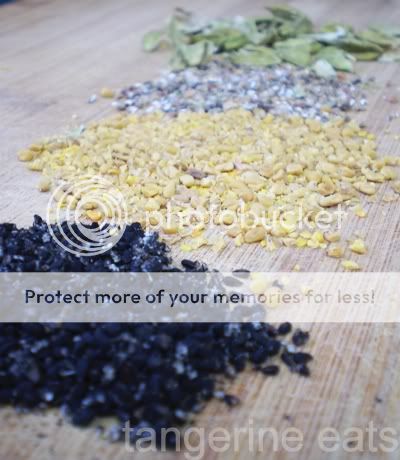
Nigella seeds, fenugreek seeds and cardamom pods ground with a mortar and pestle

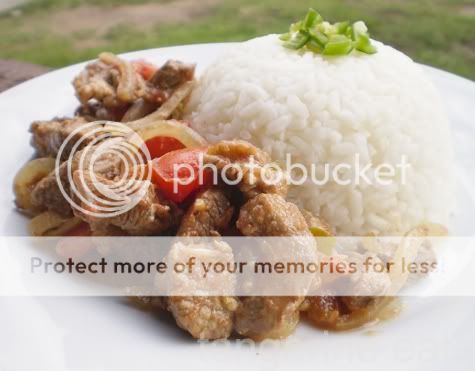
To make kulwha, you must first make niter kibbeh, a spice-infused clarified butter. 500g of unsalted butter is gently simmered for half an hour until it separates, at which point, you infuse the oil with spices and discard the milk fats. Allow to cool and you can use this as a wonderfully aromatic cooking oil.

Curdling butter

Niter kibbeh

The niter kibbeh is then cooked with olive oil, green chili, onion, tomato, an African spice mix called berbere and diced lamb over high heat to make the Eritrean stir-fry kulwha. Put this in the fridge for a few hours for the flavours to stew and then serve with injera or rice.

I love how quickly and simply this all comes together. It only needs 3 or 4 minutes in the pan so that the tomato and lamb retain their juiciness. The flavour is again surprisingly mild but delicious. It's spicy but not hot, the tomato and onion are sweet, the lamb is juicy and meaty and you can taste the distinct flavour of the niter kibbeh, which tastes as beautiful as it sounds. If you're a fan of earthy and understated spices, this is definitely worth a try.

Recipe by Rahel Ogbaghiorghis in the Food Safari cookbook.

Friday, March 19, 2010

Macarons Part I: Basic French Macaron Shell


They say that making macarons is an endeavour best left to the French. After several failed attempts, I realised that there is a lot of wisdom in that adage.


Except that when I want something, I will not stop until I succeed. Maybe it's the law student ambition in me; maybe it's my passion for food that doesn't let me shy away from a challenge.


Using David Lebovitz's blog as a starting point, I read and read about the meticulous method of making macarons. As Lebovitz explains in "Making French Macarons: Instructions & Recipes", making macarons is more about technique rather than following a recipe. For tips on macaron shell technique, I found David Lebovitz, Duncan Markham at Syrup and Tang and Corry at Bake It Off to be the most useful sources on the internet.

I tried out two recipes: Duncan Markham's recipe for a basic French macaron and Pierre Hermé's recipe for hot sugar syrup macarons. These recipes were by no means fool-proof or simple to master because they didn't involve the use of cream of tartare or lemon juice to aid the formation of stiff peaks in the egg whites. It took me about 15 eggs, almost 1kg of almond meal and 3 whole days in the kitchen to make a decent macaron shell. There were tears, tantrums and the spontaneous shouting of "Why!" and "It's not fair!" in my sleep. But imagine my joy when I'd made a bona fide French macaron!


However, it was a long learning process. My first few attempts came out porous and deflated. I couldn't understand why - I'd followed the recipes to the T. Dan's mother Barb suggested that I start from basics, beating an egg and making meringue. It made sense, getting to know the science of how the ingredients interact with each other, taking one step at a time. So that's what I did - no colouring and no added flavours (my ambitious strawberry syrup did not work with the macaron batter). I focused on the 4 ingredients used in Duncan Markham's recipe: egg whites, almond meal, icing sugar and castor sugar.

Working with the 4 ingredients


Egg whites


Using 1 egg, I tested how far I could beat it without curdling it. This gave me a better grasp of what soft, medium and stiff peaks looked like. The best way to test which stage you are at it is to stop beating every minute or so and lift the beaters out to see. When it reaches soft peaks, the egg whites will look like a sudsy foam with visible bubbles. Medium peaks means that the bubbles are barely visible and when you lift the beaters out, it will rise up and flop back down. I couldn't actually reach stiff peaks without castor sugar (as it helps bind egg whites). You will know you've got stiff peaks when the mixture is glossy, has obvious ripples and when you lift the beaters the peak will stand up on its own. Edit: Between medium and stiff peaks, the castor sugar will make the egg whites increase in volume. If it decreases in volume again, you've overbeaten it. However, it is salvageable. Bake at a lower heat for longer so that you don't get a hollow shell.


Beating egg whites is finicky enough but with macarons there are about 4 other fronts you have to worry about:


(1) Fineness and dryness of almond meal
Whether you use whole almonds (raw, not blanched) or packaged almond meal from the supermarket (which I found doesn't work that well anyway) you need to prep it before using it in macaron mix. Fineness isn't crucial but creates a smoother shell so that it's nicer on the eyes. Dryness, however, is key because excess moisture will cause the egg whites to collapse. Preheat the oven to 150°C. Blitz the almonds or almond meal in a food processor for 1 minute. Remove lid and use a spatula to loosen all the ground almond at the bottom. Blitz for another minute. Spread into a thin layer on a baking tray. Put in the oven for 5 minutes. Cool completely.


(2) Dryness and temperature of egg whites
As egg whites contain water, you want to dry out that excess moisture for perfect macarons. To do this, separate your eggs 2 days in advance. Place the egg whites in a shallow bowl and let stand at room temperature. You can cover it, but use something that'll let it breathe, like a tea towel. Egg whites beat better at room temperature, so don't fridge them during these 2 days!


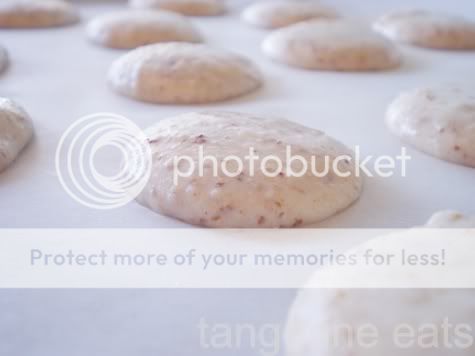
Just piped


Rested for 20 minutes


(3) Speed of incorporation
One of the most important things I learnt during my mistake runs is that you need to be fast when incorporating the dry ingredients with the wet ingredients. If you work too slowly, the egg whites will deflate and your macarons will be firm and chewy. When folding the dry ingredients into the egg whites, scrape the edge of the bowl in a semi-circle, then fold into the middle. You want to get rid of the excess air so use a bit of force.


(4) Prepping your utensils
For beating egg whites in general, always beat in a clean glass bowl, making sure that the bowl and the beaters are completely dry to begin with. Use the smallest bowl you can so that the egg whites will get maximum beatage. When baking, use thick baking trays, or stack two together (with no gap in between), lined with baking paper. You can stick down the baking paper with blobs of macaron mixture in each corner.


Macarons au blanc monté (French meringue)
Recipe courtesy of Duncan Markham ("La Macaronicite 2: basic technique and simple macaron recipe", Syrup and Tang)


1 part egg white (50g)
1.3 parts almond meal (65g)
1.6 parts icing sugar (80g)
0.8 parts castor sugar (40g)


Blitz almond meal and icing sugar in a food processor for 1 minute.


Beat the egg whites on a medium speed until medium peaks form. Gradually add castor sugar and beat until stiff peaks form.


Sprinkle half of the dry ingredients over the egg whites and fold in with a spatula. Fold in remaining dry ingredients. This is also when you would add food colourings.


When done, you should be able to make a ribbon on top that takes at least 30 seconds to disappear.


Prep baking trays and spoon batter into piping bag with a 1cm wide nozzle.


Holding the nozzle close to the baking paper, pipe your macarons about 4cm apart. Try to make them round and flat (you can dip your finger in water and smooth out the tops if needed).


Tap the tray on a flat surface to get rid of excess bubbles.


Preheat the oven to either 120°C (baking time: 20 minutes) or 180°C (baking time: 9 minutes).


Rest the shells after piping for at least half an hour in a dry place.


Bake for 18-20 minutes in the middle shelf. If doing more than one tray, bake one tray at a time.


Remove baking paper from tray and cool on a wire rack. Gently remove macaron shells from baking paper and continue cooling face up on the wire rack.


Refrigerate in an air-tight container for at least 1 day before filling.


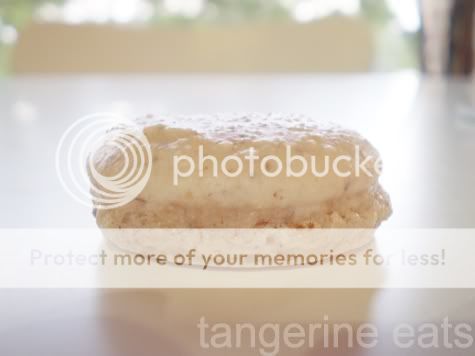
9 minutes at 180°C


20 minutes at 120°C


Stay tuned for the hot sugar syrup recipe and ganache filling!


Tuesday, March 16, 2010

Herbie's Spices, Rozelle

745 Darling St
Specialty spice store
Shop online or check here for opening times

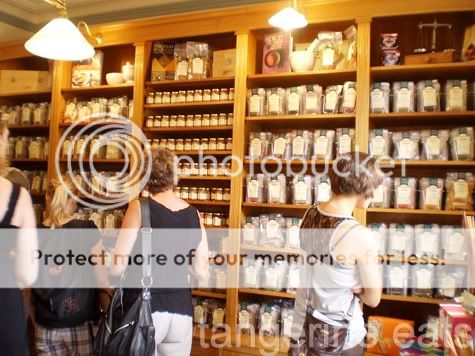
Owned by "one of Australia's foremost culinary herb and spice experts" Ian Hemphill, Herbies Spice's stocks a comprehensive myriad of exotic and hard-to-find spices, as well as locally sourced everyday spices. It's easy to understand why this store is highly sought after by foodies and chefs in Sydney.

"Tetsuya was in here on Friday. I was gushing!" the shop assistant laughed when I told her how much I loved the store.

I came here on a Sunday afternoon after a sunny stroll in Balmain. As soon as I walked in I was greeted by the most wonderful aroma of spices and herbs. By the window were tall sticks of cinnamon in vases (1m for $3.60 or 30cm for $1.20) and brightly packaged spice kits (including Asian, French Provincial and Moroccan, $30 each). The adjacent walls were literally covered with spices and herbs from around the world, from aniseed to cassia bark, grains of paradise (or melegueta pepper) to whole saffron. I was in spice heaven!

You can find almost any spice or dried herb you'll need (ground as well as in their original forms). Most useful for everyday cooking are the specialty mixed spices like the gucamole mix which I picked up (it was fantastic with nachos!). Can't find what you need? Talk to the knowledgeable staff about what to use in certain dishes and where to pick up additional ingredients for whatever culinary adventure you are on.

As you know, I'm cooking African food from the Food Safari cookbook this month. I was surprised to find that Herbie's stocked almost all of the spices and herbs I had trouble finding, including ajowan, fenugreek seeds, nigella seeds, berbere and cardamom pods. I was well chuffed.

For the kitchenware buffs, there are spice-related utensils through the Moroccan-inspired archway, including mortars and pestles and ginger graters. I personally loved the neat little Herbie's jars the spices come in. There are even empty jars for sale for you to extend your collection.

Herbie's Spices is open 7 days a week (Monday to Friday 10-5, Saturday 9-4 and Sunday 10-3) and is located on the Lilyfield end of Darling Street.

Telephone: 02 9555 6035

Website: http://herbies.com.au/

Sunday, March 14, 2010

Taste of Sydney 2010

Brazilian Fields, Centennial Park
March 11-14 - tomorrow's the last day so get down there!
Book online or buy a ticket at the door

You know the feeling you get when you've eaten so much that it pains to walk? I've only ever felt this twice in my life - once after eating at the Crown Casino buffet in Melbourne and once again tonight at the highly anticipated food festival, Taste of Sydney.

This was my first Taste experience (the festival is now in its second year) and I was so blown away that not even rain getting on my silk skirt fazed me. Just as live music is made doubly as enjoyable by a crowd sharing the same taste as you (I'm still friends with the guys I met at a Bjork concert years ago), the atmosphere tonight was fantastic being surrounded by top quality food and drink and people who really appreciate their food.

Here are my favourite picks of the night...

The Gourmet Traveller Taste Kitchen

Matt Kemp (Restaurant Balzac), Warren Turnbull (Assiette) and Colin Fassnidge (Four In Hand) doing a live demonstration on cured beef. It's always great fun to watch how professional chefs prepare their food and then plate it up ever so effortlessly.

The dishes

Everything I tried was heavenly! I got a mix of my favourite foods as well as things I don't eat very often (especially wagyu beef and panna cotta, yumm). I really wish I could've kept going into the night (the yellow curry from Longrain Restaurant smelt so good I was drawn to it from a stall away) but my stomach would only allow me to ingest so much in four hours. Guess I have to save up to visit each of the restaurants then!


Saddle of sucking pig with garden peas and smoked bacon jus, Restaurant Balzac, $12


Crispy wagyu beef with wild mushroom and truffle foam, Restaurant Balzac, $10


Sydney rock oysters with Vietnamese dressing, crispy shallot and baby coriander, Assiette, $10


Fig and Heilala vanilla ricotta tart with honey ice cream, Assiette, $8


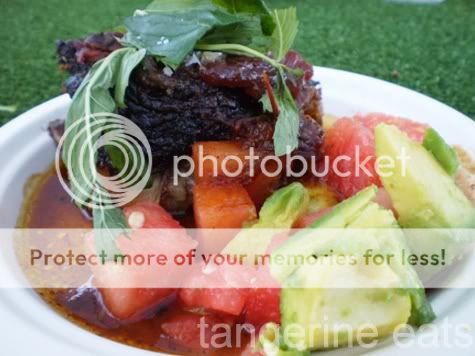
Beef ribs smoked in watermelon with a watermelon and avocado salad, Danks St Depot, $12


Yellow fin tuna with sweet pork crackling and ruby grape fruit, Flying Fish, $10


Vanilla panna cotta with lavender honey and fresh pomegranate, Jonah's at Whale Beach, $12

Longrain Cocktail Bar

Fantastic cocktail to wash it all down with: Ping Pong (lychees and passion fruit shaked with 42 Below Vodka and fresh lime juice), $12. The fresh lychee flesh and passion fruit pulp is DE-LISH.

The VIC Tourism wine, beer and cheese stall

For 2 Crowns ($2), you can try all the wines, beers and cheeses in this stall. The wine that really caught my attention was the Rutherglen Topaque. Topaque (formerly Tokay) is an intensely sweet and syrupy fortified wine. Some people would classify it as a dessert wine, but it is so indulgently honey-like (due to its slow maturisation process) that I would drink this as dessert!

I also bought some pistachio macaroons from the Guillaume at Bennelong stall ($8) and a pistachio and cardamom cupcake from the Sparkle Cupcakery stall ($4.50). Will eat them tomorrow as soon as my stomach makes room for them!

Thursday, March 11, 2010

Electrolux Cooking Class @ Fratelli Fresh, Waterloo

7 Danks St
A free class on Italian cooking
Call 02 9699 3161 on the third Tuesday of the month to book

Located on the trendy Danks St in Waterloo, this Fratelli Fresh fresh market is set up in a naturally lit warehouse space, exuding a rustic, minimalist and modern vibe. The focus is the food: fresh produce that's in season. Here you'll find your basic fruit, veg and meat staples, as well as luxuries such as pomegranates, figs (fresh and as a jam!), Italian oils, olives and cheeses (the gorgonzola is amazing!). Supplying to some of the finest restaurants in Sydney (Tetsuya's, Buon Ricordo, Marque) and to Cafe Sopra upstairs, Fratelli Fresh is the Mimco of grocery shopping.

The cooking class is geared towards beginners, but it's great fun for people of all levels. The class I took today was full of regulars and for good reason too. Just taking a glance at the menu for today got me excited. Stuffed field mushrooms with Roman beans (which had an unbelievable effort to yummyness ratio) and poached peaches with amaretto and mascarpone (poached fruit + moscato + mascarpone = yuuumm).

The class was very hands-on. We were shown quickly how to make each dish and then off to our stations to cook it ourselves. This is my best friend Justine stuffing the mushroom (yay, I knew you could cook!). I love learning by doing - you pick up so much more like how to tell when the peaches have been poached to perfection.


Stuffed field mushroom with Roman beans


Poached peach with amaretto biscuit and mascarpone

What can I say, the food was as delicious as it looks, and then some. The mushroom was buttery which went well with the intense flavour of the gorgonzola and the salad (dressed with a garlic-and-onion-infused mayonnaise). Somehow the peach was just the right sweetness to work perfectly with the mascarpone (if it was too sweet it could have brought out the sour in the mascarpone) and the amaretto gave it that crunch.

Electrolux classes are held every Tuesday, Wednesday and Thursday. Classes are taken in small groups so places are limited. Call on the third Tuesday of each month to secure a place a month in advance.

Sunday, March 7, 2010

tangerine eats...

...is getting better.

I've been sick at home the last few days and I've used my time wisely by writing out the recipes for some of my previous posts. Have a look around the blog and check out the newly added NOMs.

Don't worry, it's just a cold and bronchitis. I was bedridden delirious for a few days and for a while I lost my sense of smell (it ran away with my sense of taste), but you know what they say about absence making the heart grow fonder... I'VE MISSED BEING ABLE TO TASTE FOOD! I'll be better in a few days, which is great timing..

March for tangerine eats is going to be so much fun. Just to name a few things that I'm doing this month: a cooking class at Fratelli Fresh, Taste of Sydney, Manly World Food Markets, Duckfest and more African food (popping into Herbie's first thing next week)! So stayed tuned, stay very tuned.

Olive Bread

Who doesn't love a beautiful, warm piece of fresh bread? If you've ever made your own bread, or have bought bread from Brasserie Bread, you'd know that store-bought sliced bread does not come close at all to a fresh loaf made with love. This olive bread with potato slices and fresh rosemary on top is a taste sensation. A crispy potato crust, melt-in-your-mouth soft and fluffy bread on the inside, pieces of olive and the aroma of roasted rosemary... DELICIOUS!

Adapted from the olive bread recipe on Taste.com.au

2¼ cups plain flour
2 teaspoons dried yeast
2 teaspoons castor sugar
1 teaspoon sea salt
1 cup warm water
1 cup pitted kalamata olives, dried and roughly chopped
2 teaspoons milk
1 small potato
Fresh rosemary leaves, roughly chopped
Melted butter for brushing

Sift flour into a large bowl. Combine with yeast, sugar and salt. Make a well in the centre and add water. Mix well until dough forms and knead on a floured surface for 10 minutes. Kneading not only helps the bread rise, it's my favourite part of the process. Show it a bit of love, get to know your food.

Place dough in a lightly oiled bowl. Cover with a damp cloth and place in a warm place for one hour.

Preheat oven to 170°C.

Punch the dough with your fist to get rid of excess air.

Place on a flat and floured surface. Knead olives in. The juices from the olives may come out and separate the dough slightly, that's okay. This is what makes the lovely pull-apart bits inside the bread.

Roll into a flat oval and place on a greased baking tray.

Brush lightly with milk to create a crust.

Wash and peel the potato. Slice the potato thinly with a vegetable peeler. Place the ribbons of potato on top of the dough. Brush with butter and sprinkle with rosemary.

Bake for 40 minutes.

Rest for 5 minutes before serving.


I love how rustic this feels with my homemade bread on a chopping board my boyfriend made himself.

Fantastic with butter (butter, not margarine!), dipped in olive oil and freshly-cracked pepper or toasted with grilled gorgonzola and prosciutto. Enjoy!

Tuesday, March 2, 2010

Beer & Beef Masterclass @ MUMU Grill

70-76 Alexander St, Crows Nest
Classes are run bi-monthly, check here for dates
Call 02 9460 6877 to book

They say good things come in threes. Well MUMU Grill has pared it down to two in a neat little package: for $85, chef and owner of MUMU Grill, Craig Macindoe, teaches you everything you need to know about beef and Dan the (self-proclaimed) Beer Snob gives you the low-down on boutique beers.

The beef

Craig starts off by telling us in the kitchen why he's so passionate about organic grass-fed beef: it tastes better, it contains fats that the human body needs (with its healthy omega 6-omega 3 ratio), it is better for the environment and it is chemical/preservative-free. Ageing (air-drying) beef for 6 weeks is all it needs for its flavour to intensify and become tender. For premium organic beef, Craig recommends Hudson Meats (Cammeray, Surry Hills and Lane Cove).

We're then run through the 'sweet cuts' of beef that make up the 20% of the cow we eat. These include the eye fillet, sirloin, scotch fillet, rump and t-bone. The thing that surprised me the most is they're so simple to cook! To season, sprinkle with rock salt (to bring out the flavour in the mouth) and pepper, and lightly coat with olive oil (less is more as too much oil builds a layer of char on the beef). To sear, cook the beef on one side for 2½ minutes, rotate 90° (so that you create a criss-cross pattern on the steak) and cook for another 2½ minutes, flip and repeat. Cook until desired doneness.

One recipe I was especially intrigued by was Craig's Tagliata t-bone: sear, slice into strips, drizzle with garlic and rosemary in olive oil and place in a woodfire oven for 10-15 minutes. The result is a juicy and garlicky, melt-in-your-mouth piece of beef. I'm definitely trying this at home in my conventional oven (set at a low heat, roughly 120°).

The beer

Before Saturday I was never big on drinking beer. I've tried very hard to like it (my friends call it an acquired taste, so if you can learn to like wine, why not beer?) - I've even gone to Lowenbrau and the Belgian Beer Cafe hoping that it'd change my life and I would have an in in the world of beer. But Dan the Beer Snobhas enlightened me. Turns out, mainstream beer is different to boutique beer.

Dan tells us the three tell tale signs of a good beer: colour, clarity and carbonation (the three C's). We tried five different beers, starting with the palest (Murray's Pilsner) to the darkest (Moo Brew Dark Ale). I've got to say, I am convinced. Beer snobbery is the way to go

All in all this was a fantastic class, geared towards cooks and drinkers of all levels. I've always loved MUMU Grill, Dan's family and I have been a few times now and the love only keeps growing. Next up is Duckfest!