Showing posts with label egg whites. Show all posts

Friday, April 23, 2010

Gooey Rocky Road Soufflé

I'll let you in on a secret: when it's late at night and there's no one else on the road, I will more than likely drive over roundabouts. Of course, I also avoid my boyfriend's glares and then sheepishly explain, "I don't like moving my arms." I'm not an inactive person, I'm actually quite athletic. It's just that at the end of a long day of driving - granted curves and bends are fun - my arms are tired and roundabouts are just too much.

Likewise, some things like rocky road involve too much chewing. It tastes great, don't get me wrong, but after 3 bites my mouth is just in mastication overkill. This is why I decided to make a gooey rocky road: the same great taste but with 95% less chewing required.

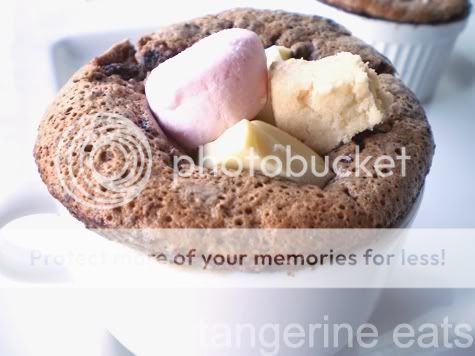
To a chocolate soufflé, I added pink marshmallows, white chocolate bits and macadamia shortbread. The white chocolate and marshmallow melt into the soufflé and you end up with a rich, intensely chocolatey soufflé with gooby bits on top. The macadamia shortbread is dense and crumbly and it all just melts in your mouth. This is exactly the kind of lazy eating that's needed for a long weekend.
Gooey Rocky Road Soufflé
Adapted from Gordon Ramsay's Chocolate Soufflé recipe

Unsalted butter for greasing, softened
6 squares dark chocolate, finely grated
20g cornflour
200ml milk
200g dark chocolate (at least 70% cocoa solids), chopped
80g egg yolks
200g egg whites
150g castor sugar
Pink marshmallows
White chocolate bits
Macadamia shortbread

Preheat oven to 180°C.

Grease the sides of 8 small ramekins with butter in upward strokes. Refrigerate for 5 minutes and grease again. Sprinkle grated chocolate on the sides evenly.

In a small saucepan, combine cornflour with a bit of milk and create a smooth paste. Gradually mix in rest of milk. Bring to the boil on low heat, whisking continuously. When the mixture thickens after around 30 seconds, add chocolate and whisk until the chocolate is melted. Remove from heat and whisk egg yolks in. Cool in a large bowl.

Beat egg whites with an electric beater. When medium peaks form, gradually add castor sugar. Beat until thick and glossy.

Carefully fold egg whites into chocolate mixture, one third at a time, until just combined.

Pour into ramekins and level off with the back of a knife.

Bake for 10-12 minutes, or until the soufflés have risen well past the rims of the ramekins.

Serve immediately with marshmallows, white chocolate bits and crumbled macadamia shortbread.
Photobucket

Friday, March 19, 2010

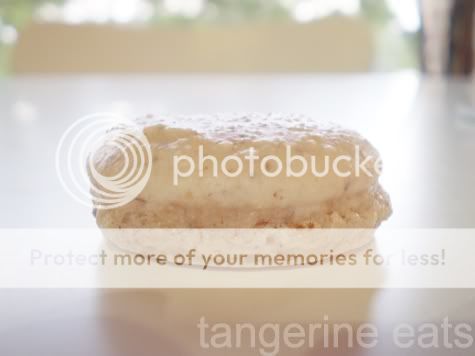
Macarons Part I: Basic French Macaron Shell


They say that making macarons is an endeavour best left to the French. After several failed attempts, I realised that there is a lot of wisdom in that adage.


Except that when I want something, I will not stop until I succeed. Maybe it's the law student ambition in me; maybe it's my passion for food that doesn't let me shy away from a challenge.


Using David Lebovitz's blog as a starting point, I read and read about the meticulous method of making macarons. As Lebovitz explains in "Making French Macarons: Instructions & Recipes", making macarons is more about technique rather than following a recipe. For tips on macaron shell technique, I found David Lebovitz, Duncan Markham at Syrup and Tang and Corry at Bake It Off to be the most useful sources on the internet.

I tried out two recipes: Duncan Markham's recipe for a basic French macaron and Pierre Hermé's recipe for hot sugar syrup macarons. These recipes were by no means fool-proof or simple to master because they didn't involve the use of cream of tartare or lemon juice to aid the formation of stiff peaks in the egg whites. It took me about 15 eggs, almost 1kg of almond meal and 3 whole days in the kitchen to make a decent macaron shell. There were tears, tantrums and the spontaneous shouting of "Why!" and "It's not fair!" in my sleep. But imagine my joy when I'd made a bona fide French macaron!


However, it was a long learning process. My first few attempts came out porous and deflated. I couldn't understand why - I'd followed the recipes to the T. Dan's mother Barb suggested that I start from basics, beating an egg and making meringue. It made sense, getting to know the science of how the ingredients interact with each other, taking one step at a time. So that's what I did - no colouring and no added flavours (my ambitious strawberry syrup did not work with the macaron batter). I focused on the 4 ingredients used in Duncan Markham's recipe: egg whites, almond meal, icing sugar and castor sugar.

Working with the 4 ingredients


Egg whites


Using 1 egg, I tested how far I could beat it without curdling it. This gave me a better grasp of what soft, medium and stiff peaks looked like. The best way to test which stage you are at it is to stop beating every minute or so and lift the beaters out to see. When it reaches soft peaks, the egg whites will look like a sudsy foam with visible bubbles. Medium peaks means that the bubbles are barely visible and when you lift the beaters out, it will rise up and flop back down. I couldn't actually reach stiff peaks without castor sugar (as it helps bind egg whites). You will know you've got stiff peaks when the mixture is glossy, has obvious ripples and when you lift the beaters the peak will stand up on its own. Edit: Between medium and stiff peaks, the castor sugar will make the egg whites increase in volume. If it decreases in volume again, you've overbeaten it. However, it is salvageable. Bake at a lower heat for longer so that you don't get a hollow shell.


Beating egg whites is finicky enough but with macarons there are about 4 other fronts you have to worry about:


(1) Fineness and dryness of almond meal
Whether you use whole almonds (raw, not blanched) or packaged almond meal from the supermarket (which I found doesn't work that well anyway) you need to prep it before using it in macaron mix. Fineness isn't crucial but creates a smoother shell so that it's nicer on the eyes. Dryness, however, is key because excess moisture will cause the egg whites to collapse. Preheat the oven to 150°C. Blitz the almonds or almond meal in a food processor for 1 minute. Remove lid and use a spatula to loosen all the ground almond at the bottom. Blitz for another minute. Spread into a thin layer on a baking tray. Put in the oven for 5 minutes. Cool completely.


(2) Dryness and temperature of egg whites
As egg whites contain water, you want to dry out that excess moisture for perfect macarons. To do this, separate your eggs 2 days in advance. Place the egg whites in a shallow bowl and let stand at room temperature. You can cover it, but use something that'll let it breathe, like a tea towel. Egg whites beat better at room temperature, so don't fridge them during these 2 days!


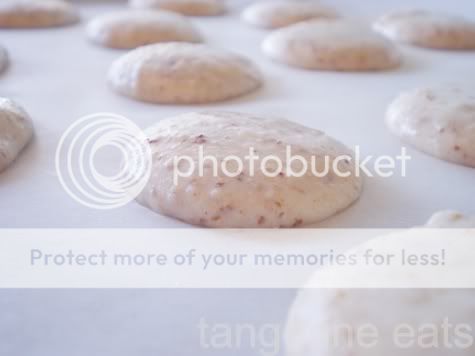
Just piped


Rested for 20 minutes


(3) Speed of incorporation
One of the most important things I learnt during my mistake runs is that you need to be fast when incorporating the dry ingredients with the wet ingredients. If you work too slowly, the egg whites will deflate and your macarons will be firm and chewy. When folding the dry ingredients into the egg whites, scrape the edge of the bowl in a semi-circle, then fold into the middle. You want to get rid of the excess air so use a bit of force.


(4) Prepping your utensils
For beating egg whites in general, always beat in a clean glass bowl, making sure that the bowl and the beaters are completely dry to begin with. Use the smallest bowl you can so that the egg whites will get maximum beatage. When baking, use thick baking trays, or stack two together (with no gap in between), lined with baking paper. You can stick down the baking paper with blobs of macaron mixture in each corner.


Macarons au blanc monté (French meringue)
Recipe courtesy of Duncan Markham ("La Macaronicite 2: basic technique and simple macaron recipe", Syrup and Tang)


1 part egg white (50g)
1.3 parts almond meal (65g)
1.6 parts icing sugar (80g)
0.8 parts castor sugar (40g)


Blitz almond meal and icing sugar in a food processor for 1 minute.


Beat the egg whites on a medium speed until medium peaks form. Gradually add castor sugar and beat until stiff peaks form.


Sprinkle half of the dry ingredients over the egg whites and fold in with a spatula. Fold in remaining dry ingredients. This is also when you would add food colourings.


When done, you should be able to make a ribbon on top that takes at least 30 seconds to disappear.


Prep baking trays and spoon batter into piping bag with a 1cm wide nozzle.


Holding the nozzle close to the baking paper, pipe your macarons about 4cm apart. Try to make them round and flat (you can dip your finger in water and smooth out the tops if needed).


Tap the tray on a flat surface to get rid of excess bubbles.


Preheat the oven to either 120°C (baking time: 20 minutes) or 180°C (baking time: 9 minutes).


Rest the shells after piping for at least half an hour in a dry place.


Bake for 18-20 minutes in the middle shelf. If doing more than one tray, bake one tray at a time.


Remove baking paper from tray and cool on a wire rack. Gently remove macaron shells from baking paper and continue cooling face up on the wire rack.


Refrigerate in an air-tight container for at least 1 day before filling.


9 minutes at 180°C


20 minutes at 120°C


Stay tuned for the hot sugar syrup recipe and ganache filling!


Thursday, January 21, 2010

Chocolate Mousse Trifle

When I think Summer, I think pastel sundresses, straw hats and fun-shaped popsicles. However, since chocolate cravings transcend seasons and I love the way the blood pink of cooked strawberries looks under the sun, this chocolate mousse and strawberry trifle is a fitting way to kick off this blog on a fine Summer's day. It is so simple to make and so, so delicious.


You'll need:

100g milk chocolate, melted
100g dark chocolate, melted
6 egg whites
230ml thickened cream
¼ cup icing sugar
1 punnet strawberries
¼ cup sugar
¼ cup water
8-10 Butterscotch Fingers
Kahlua

Serves 4-6

Place strawberries, sugar and water in a saucepan and simmer over low heat until the syrup becomes a deep red. Cool in fridge.

Melt chocolate in a glass bowl above simmering water. Use the lowest heat. Remove from heat right before the last pieces melt completely.

Beat egg whites until soft peaks form.

Fold the melted chocolate into the thickened cream. Fold in egg whites and icing sugar.

Layer strawberry coulis, biscuits (drizzled with Kahlua) and mousse mixture into martini glasses.

Set in freezer for 3 hours.

This mousse is ridiculously rich and indulgent. It's intensely chocolatey, velvety and thick - well worthy of the attention a main course demands. Enjoy slowly!